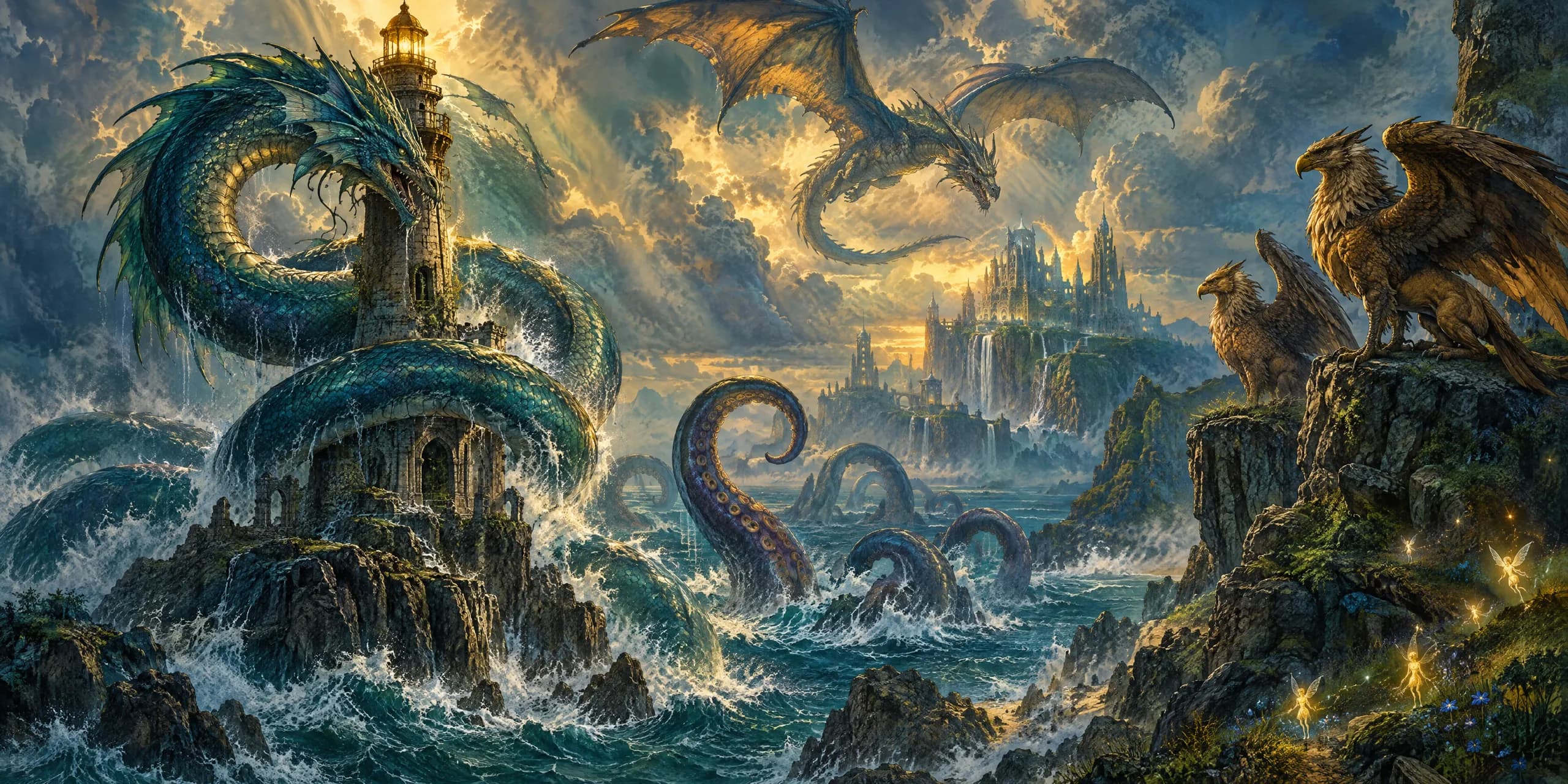
 The Dragon Races, painted for this archive
Hydra
Creature, The Dragon Races
Multi-headed giant reptiles related to dragons, hydra can have up to nine heads, reportedly gaining one about every hundred years, and regrow lost parts within seven days. Known species include the common hydra, the fire-breathing pyrohydra, the rare aquahydra and the winged ouranabad; semi-intelligent and territorial, they leave the inedible remains of their prey, treasure included, strewn about their lairs.
From the book
Hydra are rare giant reptiles thought to be kin to dragons. They are generally smaller than dragons, with thick, muscular bodies and shorter tails, and above all they have several heads, which marks them out from the rest of dragonkind. A hydra can have up to nine, and each can act on its own. Some scholars argue that one dominant head directs the body, but no one has proved it. A more popular idea holds that a hydra grows a new head about once a century, so counting heads gives its age. Lost or injured parts grow back in about seven days (the appendix gives 2-7 days).
Besides the winged ouranabad, known species include the common or fanged hydra, largest and strongest; the pyrohydra, which breathes fire and is thought the most aggressive; and the aquahydra, a water-dweller so little known that some naturalists think it died out long ago.
Semi-intelligent hunters of smaller animals, hydra lair in caves or abandoned buildings, patrol their territory closely and, unlike dragons, rarely sleep for long. Both parents hunt and always carry prey home to eat, and they feed and protect their young until they can fend for themselves. Being filthy feeders, they leave the inedible leftovers, such as bones, armor, coins and weapons, lying around the lair, which may hold riches or nothing at all. Young hydra with two or three heads can be trained as guard beasts, and the few trained ones fetch over 10,000 gold pieces from choosy buyers, but no one has managed to raise a hydra from a captured egg.
By the appendix a hydra's level equals its number of heads; the young hatch with two and gain another every 1-4 years, a far faster rate than the chapter's hundred-year estimate. Every species heals 1 hit point a minute. A pyrohydra can breathe fire once a day for 2-12 damage per head, and an aquahydra can breathe water.
At a glance
- Level
- Equal to its number of heads; young have 2 and grow one more every 1-4 years
- Type
- Giant reptilian related to dragons; smaller, stout torso, shorter tail
- Heads
- Up to nine, each acting independently; a hydra is thought to add a head roughly every 100 years, so head count indicates age
- Regeneration
- Regrows lost or damaged members in about seven days
- Species
- Common or 'fanged' hydra (largest, most powerful); pyrohydra (fire-breathing, most aggressive); aquahydra (rare water-dweller, possibly extinct); ouranabad (winged hydra)
- Intelligence
- Semi-intelligent
- Habitat
- Caves; some prefer abandoned man-made structures
- Behavior
- Territorial, vigilant patrols; rarely sleep for long periods; both parents hunt and carry prey back to the lair; young are fed and protected until able to fend for themselves
- Treasure
- Bones, armor, coins and weapons of prey left strewn about the lair; may be valuable or worthless
- Trade
- Young hydra (2-3 heads) are trainable as guard beasts, reportedly fetching upwards of 10,000 gold pieces once trained; captured eggs cannot be raised
- Unproven theory
- Some scholars claim a single dominant head coordinates the body
- Height/Length
- Up to 25 ft.
- Weight
- 8,000-12,000 + lbs.
- STR
- 17
- SPD
- 5
- DEX
- 8
- CON
- 19
- INT
- 4
- WILL
- 14
- CHA
- 5
- PER
- 16
- Alignment
- Neutral
- Damage
- Bite: 1-8 each, Claws: 1-6
- Special Attributes
- All species heal 1 h.p. per minute and regrow lost appendages in 2-7 days; the Pyrohydra breathes fire once a day for 2-12 damage per head; the Aquahydra breathes water
- Armor
- As chain mail
- Hit Points
- 4-6 per level
- Found in
- Hesperia, Gondwana, Jambu, Lemuria/Mu/Elysium Sea, Mediterranea
- Comments
- Its level equals its number of heads; young are born with two heads and grow one more every 1-4 years; each head can attack on its own
The chapter (p.51) says lost parts regrow in about seven days and suggests a new head roughly every hundred years; the appendix (p.107) gives regrowth in 2-7 days and says young are born with two heads and add one every 1-4 years.